
Rebuilding the Roof of the Mouth
This reading contains every idea and every piece of evidence needed for today's decision. The research links at the end are optional.
Why this matters
Palate repair usually happens at 9 to 15 months, and the goal is a working seal for feeding and speech, not only a closed opening.
The question you are trying to answer
Why is closing the roof of the mouth not enough to make it work?
Begin with the idea you already earned
Lip repair restores a continuous orbicularis ring and aligned lip landmarks, not merely a closed skin line.
Study the analogy before the biology
- What happens if the deck closes but the cables remain misdirected?
- Which parts must move after repair?
- Why must the repair protect its supply lines?
Turn the analogy into three rules
Limit: The soft palate is a living neuromuscular valve, not a bridge mechanism.
Map those rules onto the biology
Palatoplasty closes the opening between mouth and nose using living tissue layers.
When the soft palate is involved, the levator muscles should be reconstructed into a functional sling.
The team also protects blood supply and monitors bleeding and airway risk. Later speech, fistula, and facial growth remain part of follow-up.
Read Mateo's labeled case evidence
Mateo's cleft opens through hard and soft palate.
Both oral-nasal separation and soft-palate function need repair.
His levator fibers are abnormally oriented along the cleft margins.
Functional repair requires muscle reconstruction, not mucosal closure alone.
Palate surgery can risk bleeding, tissue injury, airway obstruction, fistula, and later growth effects.
A plan must include safety and surveillance, not only closure.
Make the concrete decision
You are the cleft surgeon presenting two palatoplasty plans.
One plan closes lining only. The other closes layers, rebuilds the levator sling, preserves vascular supply, and includes airway monitoring.
- Choose the functional layered plan.
- Choose lining closure only because no visible hole remains.
- Delay every palate repair until adulthood to avoid all growth effects.
Choose the plan and cite closure, muscle, and safety evidence.
Claim ceiling: You may identify required goals and risks. You may not name one palatoplasty technique as best for every patient.
Write the 10-year takeaway
Palate repair must close the oral-nasal opening and rebuild the levator sling while protecting blood supply and growth.
- What two functional goals must palatoplasty meet?
- Why is airway monitoring part of the plan?
Glossary in plain English
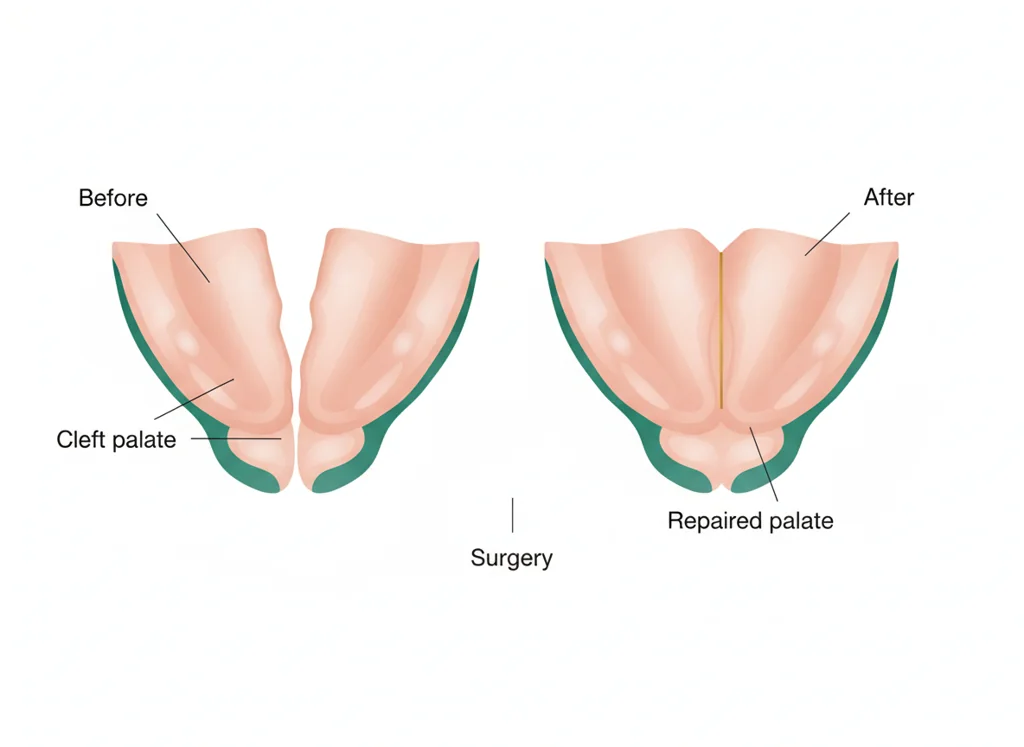
Surgery that closes a cleft in the roof of the mouth so the palate can separate the nose from the mouth and support speech.
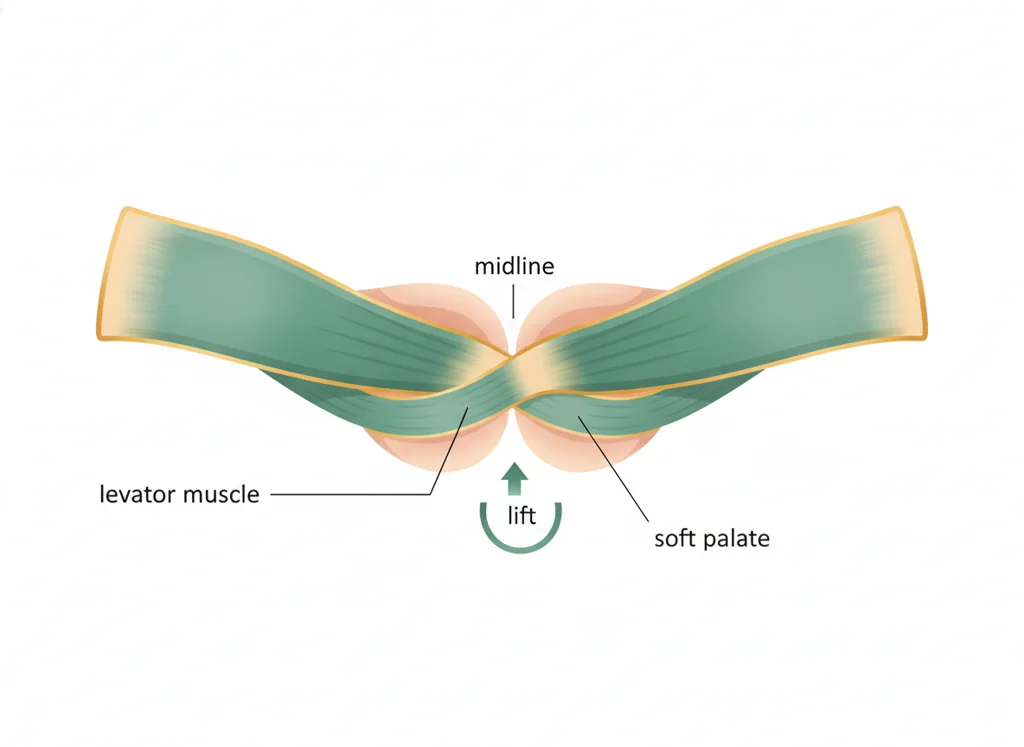
The main muscle that lifts the soft palate to close off the nose during speech and swallowing; it is often disrupted in cleft palate.
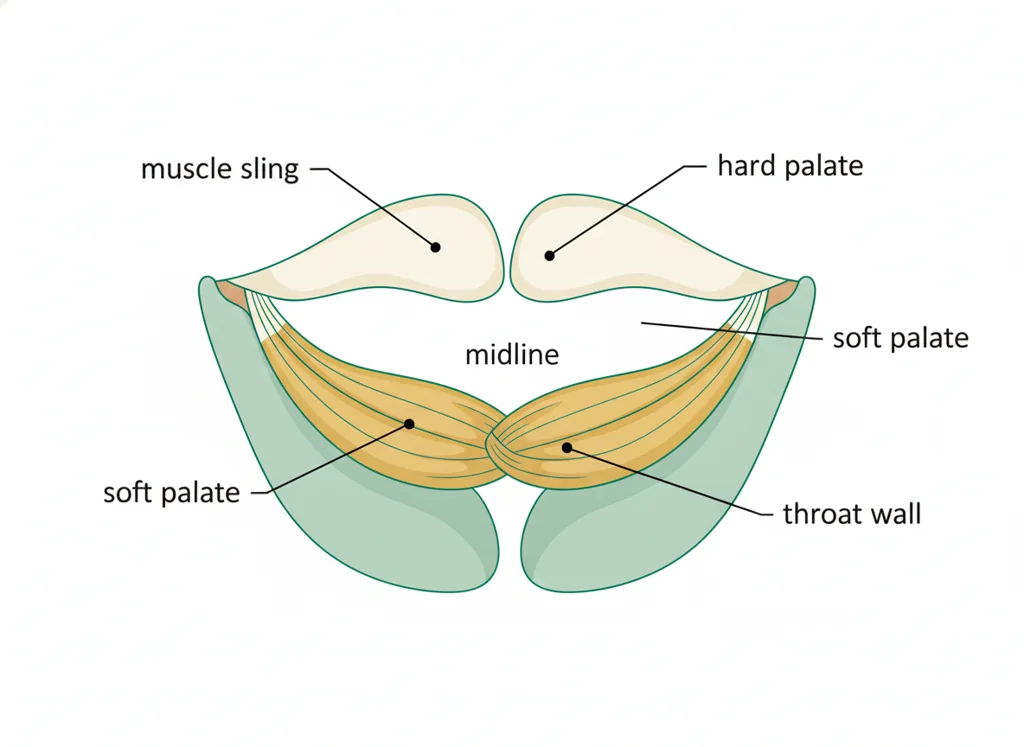
The hammock of soft palate muscles that meet in the midline so the palate can lift and seal the nose off during speech and swallowing.
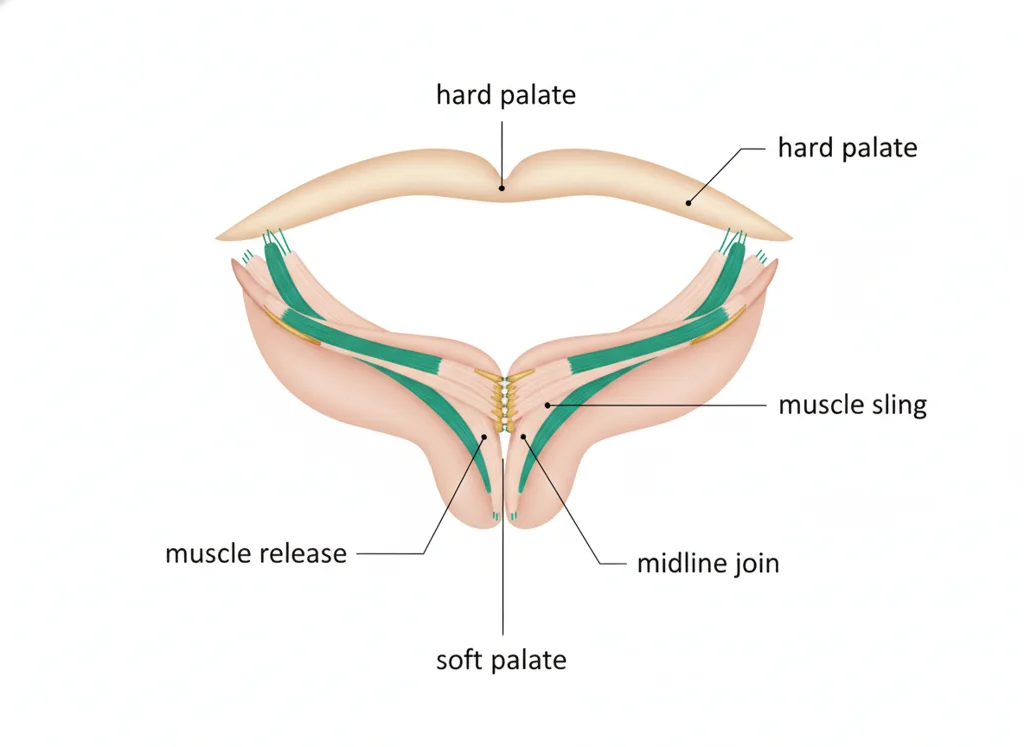
A cleft palate surgery that frees the soft palate muscles from their wrong attachments and reconnects them across the midline to rebuild the muscle sling.
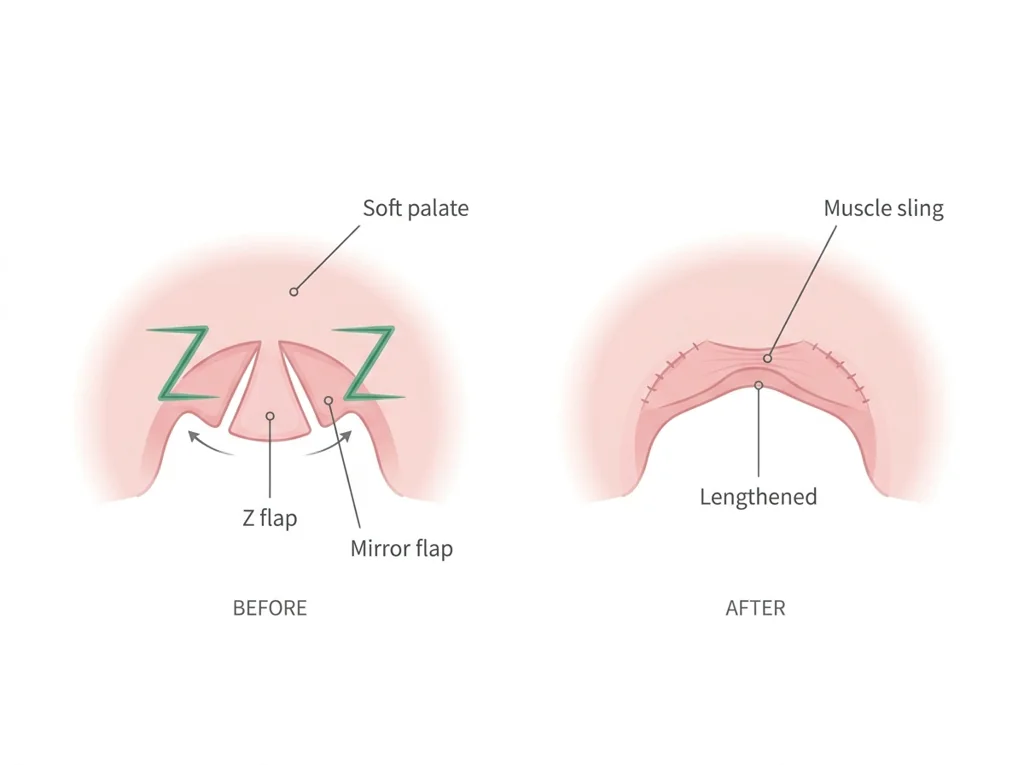
A cleft palate surgery (the Furlow technique) that uses mirror-image Z-shaped flaps to lengthen the soft palate and rebuild its muscle sling.
Research citation trail (advanced)
You do not need these papers or database records to finish the lesson. They document where the plain-language explainer's claims come from and are intended for teachers or advanced readers.
- American Cleft Palate Craniofacial Association. 2024 Parameters of Care.
- Lindeborg et al. 2020, Optimizing speech outcomes for cleft palate (Curr Opin Otolaryngol HNS)
- Brooker et al. 2021, Furlow Double-Opposing Z-Plasty for Submucous Cleft (Plast Reconstr Surg)
- Huang et al. 2023, Sommerlad-Furlow modified palatoplasty, 1254 patients (J Craniomaxillofac Surg)