
CER: Claim, Evidence, Reasoning
Answer a scientific question with a clear claim, the data that supports it, and the reasoning that ties them together.
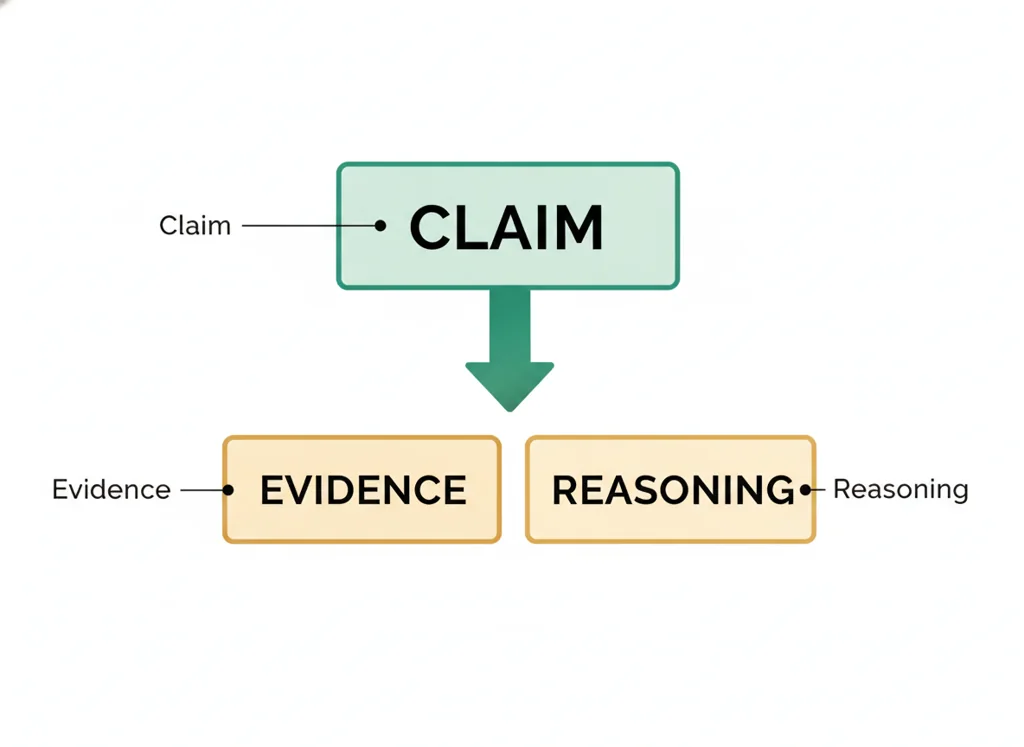
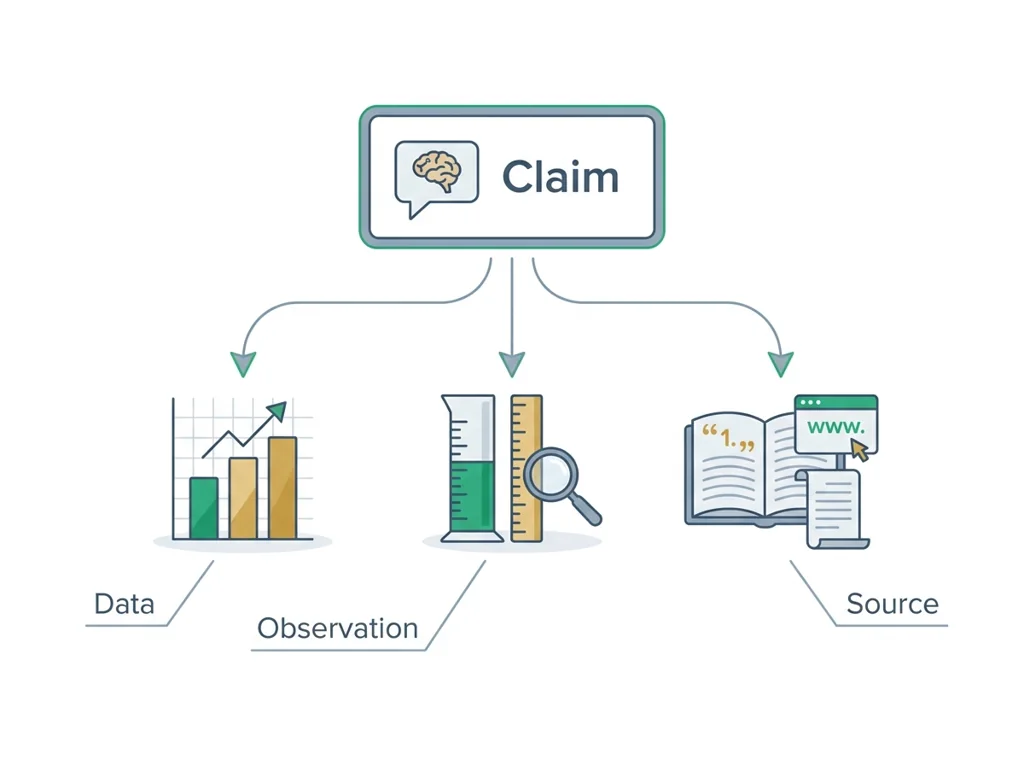
In science you are never believed just because you say so; you are believed because your evidence and reasoning make the case. CER is the backbone of that argument: a Claim answers the question, Evidence is the specific data that supports it, and Reasoning explains why that evidence proves the claim using a scientific idea. Doctors use CER when they justify a diagnosis from test results, lawyers when they argue from facts, engineers when they defend a design choice, and every scientist when they write a conclusion or a paper's discussion. Learn to separate these three moves and your writing stops sounding like an opinion and starts sounding like a finding.
- Common Core · WHST.9-10.1Write arguments focused on discipline-specific content, supporting claims with logical reasoning and relevant, sufficient evidence.
- Common Core · RST.9-10.1Cite specific textual/data evidence to support analysis of science and technical texts.
- NGSS · SEP-7Engaging in Argument from Evidence: construct and defend a claim using evidence and reasoning.
- Ohio · Ohio ELA W.9-10.1Write arguments to support claims using valid reasoning and relevant, sufficient evidence.
- AP · AP Bio SP 6Develop and justify scientific arguments using evidence; explain how evidence supports or refutes a claim.
- Read values from a data table or graph: Evidence is pulled straight from the data, so students must be able to read a table or graph accurately.
- Tell a question apart from its answer: A claim must answer the question, not repeat it, so students first need to identify what is being asked.
- State a cause-and-effect idea in a sentence: Reasoning relies on naming a scientific principle that links cause to effect.
Prerequisites are inferred: pending teacher review.
Re-learn the skill with worked practice and clear examples.
Write a full CER paragraph in order: Claim, then Evidence with real numbers from the data, then Reasoning that uses a science idea to explain why the evidence supports the claim. Use the data table below and follow the worked model.
| Group | Average height (cm) |
|---|---|
| Control (no fertilizer) | 9 |
| Fertilizer A | 15 |
| Fertilizer B | 24 |
Using the table (Control 9 cm, A 15 cm, B 24 cm), which is the BEST evidence sentence for the claim 'Fertilizer B grew the tallest plants'?
Reviewed| Group | Average height (cm) |
|---|---|
| Control (no fertilizer) | 9 |
| Fertilizer A | 15 |
| Fertilizer B | 24 |
- A.Plants grow taller when they get more of the nutrient they lack.
- B.Fertilizer B is the best fertilizer, so everyone should use it.
- C.Fertilizer B averaged 24 cm, Fertilizer A 15 cm, and the control 9 cm.
- D.The plants that got fertilizer grew taller than the plants that got none.
Show the worked solution ▾
Answer: C. Fertilizer B averaged 24 cm, Fertilizer A 15 cm, and the control 9 cm.
- Step 1: Evidence needs specific numbers: The best evidence cites the actual averages from the table.
- Step 2: Compare options: Only option B gives the specific comparative data (24 vs 15 vs 9).
Why it's right: Strong evidence cites specific data; naming 24 cm, 15 cm, and 9 cm directly supports the claim about Fertilizer B.
- A: This is the science principle, which belongs in the reasoning, not the evidence.
- B: This repeats the claim and adds advice, but reports no measurement.
- D: This names no numbers and lumps A in with B, so it cannot single out B.
Aligned to Common Core RST.9-10.1: cite sufficient data · reading level ~grade 9
A student wrote: 'Fertilizer B grew the tallest plants. Fertilizer B averaged 24 cm versus 9 cm for the control.' What is MISSING to make it a complete CER?
Reviewed- A.A claim that answers which fertilizer grew the tallest plants
- B.Nothing, because a claim plus the numbers already answers the question
- C.Evidence that gives the measured heights of the groups
- D.Reasoning that explains why the data supports the claim
Show the worked solution ▾
Answer: D. Reasoning that explains why the data supports the claim
- Step 1: Check for all three parts: There is a claim (B was tallest) and evidence (24 vs 9 cm), but no sentence explaining why.
- Step 2: Name what is absent: The reasoning, the science idea linking the numbers to the claim, is missing.
Why it's right: The paragraph has a claim and evidence but no reasoning connecting the data to the claim, so reasoning is what is missing.
- A: The claim is already there: 'Fertilizer B grew the tallest plants.'
- B: A claim and numbers are only two of the three parts; the link between them is missing.
- C: The evidence is already there: 24 cm against 9 cm for the control.
Aligned to NGSS SEP-7: complete an argument · reading level ~grade 9
Which sentence is the best REASONING to finish the paragraph above?
Reviewed- A.We measured every plant with a centimeter ruler after three weeks and averaged each group's heights.
- B.Plants grow taller when the limiting nutrient increases, so B's average shows it supplied more.
- C.Fertilizer B is the best because it grew the tallest plants.
- D.Fertilizer B averaged 24 cm while the control averaged 9 cm, a difference of 15 cm.
Show the worked solution ▾
Answer: B. Plants grow taller when the limiting nutrient increases, so B's average shows it supplied more.
- Step 1: Reasoning uses a science idea: Look for the option that states a science rule and applies it to the data; a 'because' that only repeats the claim is not a rule.
- Step 2: Compare options: Only option B explains WHY the taller average supports the claim, using a nutrient principle.
Why it's right: Reasoning connects evidence to claim with a scientific principle; option B explains why a taller average means more of the limiting nutrient.
- A: This is the procedure we followed, not a reason the data supports the claim.
- C: This uses the claim as its own reason, so it explains nothing.
- D: This restates the evidence, and the subtraction is still data, not a science idea.
Aligned to Common Core WHST.9-10.1: reasoning links evidence to claim · reading level ~grade 9
- A student writes the conclusion of a PLTW lab as a labeled CER paragraph.
- A test-taker answers a short-response prompt by stating a claim, then quoting two data points, then explaining the link.
- A group revises a weak conclusion by adding the missing reasoning sentence.
Fill these in as you work through the lesson.
- Claim (one-sentence answer to the question):
- Evidence (specific data from the investigation):
- Reasoning (the science idea linking evidence to claim):
- Rebuttal (name and dismiss an alternative explanation):
Claim answers the ; Evidence gives specific ; Reasoning explains the evidence supports the claim using a science idea.
- Write a one-sentence claim for the question 'Which fertilizer grew the tallest plants?'
- From the table, which two numbers would you cite as evidence, and why those?
- Write a reasoning sentence that uses a science idea to connect your evidence to your claim.
Turn these into one CER paragraph: data shows Fertilizer B = 24 cm, control = 9 cm. Claim: ____. Evidence: ____. Reasoning: ____.
The vocabulary of this topic, shown in the way you will meet it.
| Group | Average height (cm) |
|---|---|
| Control (no fertilizer) | 9 |
| Fertilizer A | 15 |
| Fertilizer B | 24 |