
Writing Abstracts
Summarize a whole study in about 4 to 6 sentences: the purpose, brief methods, the key result with a number, and the conclusion, written so it stands alone.
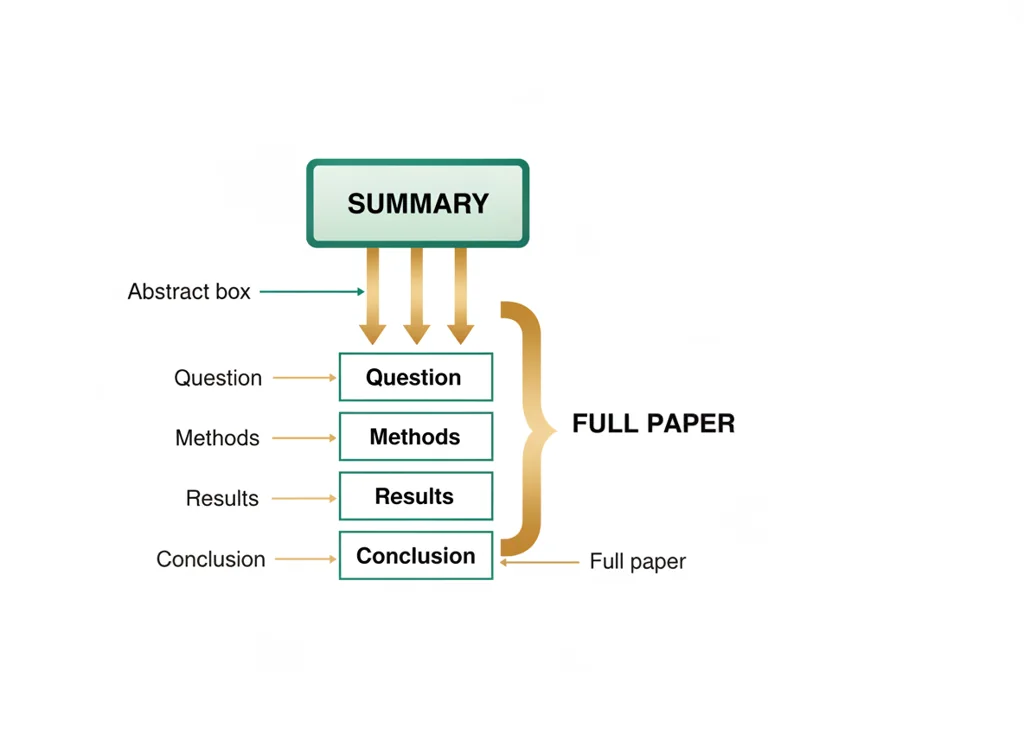
The abstract is the first thing anyone reads and often the only thing they finish, so it does more work than any other paragraph in a paper. A good abstract packs a whole study into about 4 to 6 sentences: why you did it (purpose), how you did it (brief methods), what you found (a key result with a number), and what it means (conclusion). It has to stand alone, with no citations, no figures, and no jargon a reader cannot follow. Researchers write the abstract last, once the results are final, then use it to decide whether the full paper is worth their time. Scientists scan hundreds of abstracts to plan a literature review, physicians read them to keep up with new treatments, and journal editors use them to sort what gets sent out for review. Learn to compress a study into a few precise, self-contained sentences and your writing becomes something busy people will actually read.
- Common Core · WHST.9-10.2Write informative/explanatory texts, including scientific procedures and results, that convey complex ideas clearly and accurately.
- Common Core · RST.9-10.2Determine the central ideas of a science or technical text and provide an accurate summary that stays true to the source.
- NGSS · SEP-8Obtaining, Evaluating, and Communicating Information: communicate scientific findings clearly and concisely for a specific audience.
- Ohio · Ohio ELA W.9-10.2Write clear informative texts that examine a topic and convey ideas through accurate selection and summary of content.
- AP · AP Bio SP 6Communicate scientific arguments and results accurately and concisely, including a summary of purpose, methods, results, and conclusion.
- Name the sections of a lab report: An abstract is a mini-version of the whole report, so students first need to know what purpose, methods, results, and conclusion each do.
- Read a key number from a data table or graph: The key result in an abstract must state a specific number, so students must be able to pull that number from the data.
- Summarize a paragraph in one sentence: Writing an abstract is compressing many pages into a few sentences, which builds on plain one-sentence summarizing.
Prerequisites are inferred: pending teacher review.
Re-learn the skill with worked practice and clear examples.
Build a full abstract by writing one sentence for each part, in order: purpose, brief methods, key result with a number, and conclusion. Use the labeled model abstract below, then practice matching sentences to parts and fixing a weak one that hides its number.
| Part | Example sentence |
|---|---|
| Purpose | This study tested whether soap or hand sanitizer removes more bacteria from skin. |
| Brief methods | Volunteers cleaned one hand with soap and one with sanitizer, then we counted bacterial colonies. |
| Key result | Soap removed 92 percent of bacteria, compared with 71 percent for sanitizer. |
| Conclusion | Washing with soap appears to be the more effective way to reduce bacteria on skin. |
Using the model abstract in the table, which sentence is the KEY RESULT?
Reviewed| Part | Example sentence |
|---|---|
| Purpose | This study tested whether soap or hand sanitizer removes more bacteria from skin. |
| Brief methods | Volunteers cleaned one hand with soap and one with sanitizer, then we counted bacterial colonies. |
| Key result | Soap removed 92 percent of bacteria, compared with 71 percent for sanitizer. |
| Conclusion | Washing with soap appears to be the more effective way to reduce bacteria on skin. |
- A.Volunteers cleaned one hand with soap and one with sanitizer, then we counted bacterial colonies.
- B.This study tested whether soap or hand sanitizer removes more bacteria from skin.
- C.Soap removed 92 percent of bacteria, compared with 71 percent for sanitizer.
- D.Washing with soap appears to be the more effective way to reduce bacteria on skin.
Show the worked solution ▾
Answer: C. Soap removed 92 percent of bacteria, compared with 71 percent for sanitizer.
- Step 1: Recall what a key result is: The key result is the main finding, stated with a specific number.
- Step 2: Find the sentence with the number: Only one sentence reports a measured finding, 92 percent versus 71 percent, so that is the key result.
Why it's right: The key result is the main finding stated with a number; '92 percent, compared with 71 percent' is the only sentence that reports measured data.
- A: This is the brief methods: it says how the test was done.
- B: This is the purpose: it states the question, not a finding.
- D: This is the conclusion: it says what the result means, but reports no number.
Aligned to Common Core RST.9-10.2: identify the central finding · reading level ~grade 9
An abstract reads: 'This study tested whether soap or sanitizer removes more bacteria. Volunteers cleaned one hand with each, then colonies were counted. Washing with soap appears to be the better choice.' Which part is MISSING?
Reviewed- A.Nothing; it is complete
- B.The brief methods
- C.The key result with a number
- D.The purpose
Show the worked solution ▾
Answer: C. The key result with a number
- Step 1: Check for all four parts: It has a purpose (the question), brief methods (cleaned and counted), and a conclusion (soap is better).
- Step 2: Name what is absent: There is no sentence reporting the main finding with a number, so the key result is missing.
Why it's right: The abstract states the purpose, methods, and conclusion but never gives the main finding with a number, so the key result is what is missing.
- A: It is not complete; the numbered result is absent.
- B: The brief methods are present: cleaning each hand and counting colonies.
- D: The purpose is present: it names the question being tested.
Aligned to NGSS SEP-8: report a result clearly · reading level ~grade 9
A student wrote this weak result sentence: 'Soap worked way better than sanitizer, as you can see in Figure 2.' Using the data table, which is the BEST fix for an abstract?
Reviewed| Method | Bacteria removed (%) |
|---|---|
| Hand sanitizer | 71 |
| Soap | 92 |
- A.Soap worked way better than sanitizer, as you can see in Figure 2.
- B.Soap was much more effective at removing bacteria than sanitizer was.
- C.Soap removed 92 percent of bacteria, compared with 71 percent for sanitizer.
- D.As shown in the figure, soap clearly beat sanitizer by a lot.
Show the worked solution ▾
Answer: C. Soap removed 92 percent of bacteria, compared with 71 percent for sanitizer.
- Step 1: Spot the two problems: The weak sentence has no number and it points to 'Figure 2', which breaks the stand-alone rule.
- Step 2: Fix both: State the numbers from the table (92 percent and 71 percent) in words and drop the reference to the figure.
Why it's right: A strong abstract result states the number and stands alone; '92 percent versus 71 percent' gives the data in words with no reference to a figure.
- A: This is the weak original: no number and it points to Figure 2.
- B: It has no number, so it is still vague even though it drops the figure reference.
- D: It still refers to 'the figure', which breaks the stand-alone rule, and gives no number.
Aligned to Common Core WHST.9-10.2: report precise, standalone results · reading level ~grade 9
- A student turns a finished PLTW lab into a four-sentence abstract at the top of the report.
- A group swaps a vague result sentence for one that states the exact number.
- A writer deletes every 'see Figure' from a draft abstract so it can stand alone.
Fill these in as you work through the lesson.
- Purpose (the question or goal, stated first):
- Key result (the main finding, with a number):
- Stands alone (no citations, no figures; understandable by itself):
- Conclusion (what the result means, without overclaiming):
An abstract states the first, then brief methods, then the key with a number, then the conclusion; it is written and it must stand .
- List the four parts of an abstract, in order.
- Explain in one sentence why the abstract is written last even though it appears first.
- Rewrite 'Soap worked way better, see Figure 2' as a proper abstract result using the number 92 percent.
Turn this into a 4-part abstract. Data: soap removed 92 percent of bacteria, sanitizer removed 71 percent. Purpose: ____. Methods: ____. Result: ____. Conclusion: ____.
The vocabulary of this topic, shown in the way you will meet it.
| Wordy (cut this) | Concise (keep this) |
|---|---|
| We carried out many careful measurements over a long period of time | We measured for two weeks |
| The results, as you can clearly see, were extremely and notably higher | Growth was 24 cm, higher than the control |