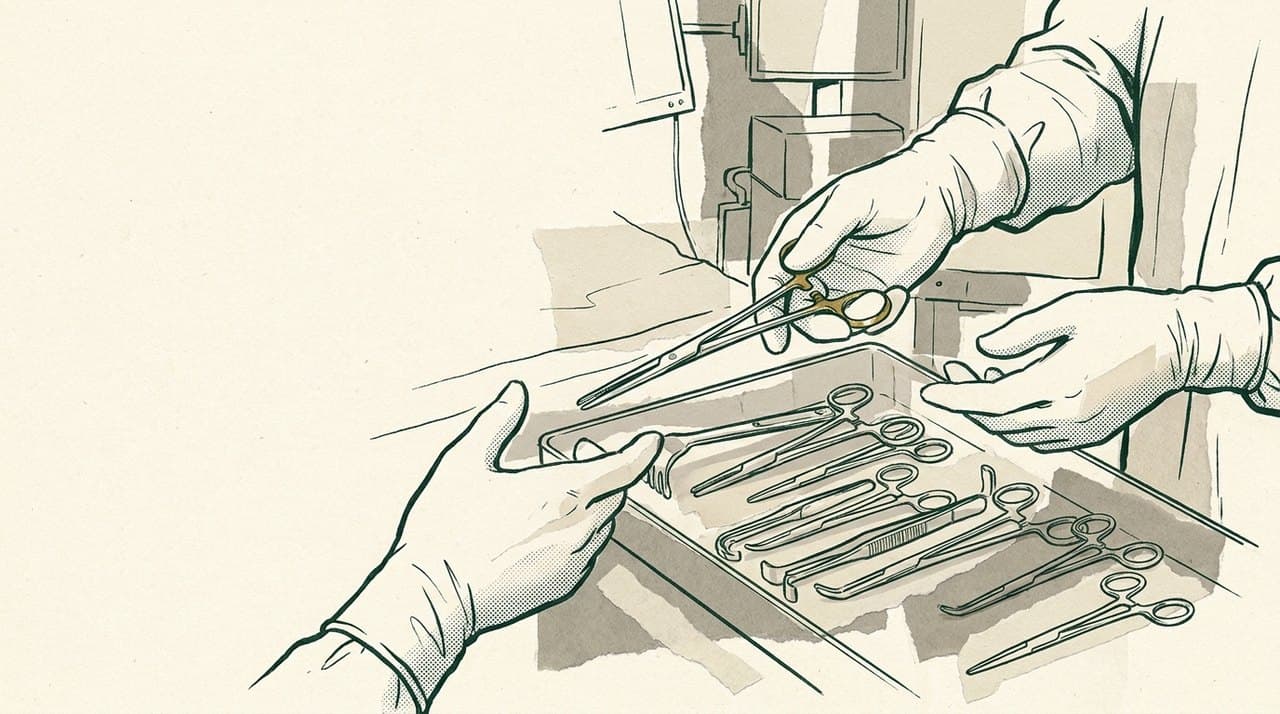
A surgical technologist is the person in the operating room who sets up the sterile instruments, hands the surgeon the right tool the instant it is asked for, and counts every sponge and needle before and after the operation so nothing is left inside the patient.
Set up the room before the patient comes in: open sterile supplies, lay out the instrument tray in the order the surgeon will want it, and check that the equipment works.
Scrub, gown, and glove, help the rest of the team gown and glove, then protect the sterile field for the entire case. O*NET reports 79 percent of surgical technologists wear protective equipment every day.
Pass instruments and supplies the moment the surgeon asks, hold retractors, and cut sutures.
Count sponges, needles, and instruments before and after the operation, then help move the patient to recovery.
Stand still and stand close for long stretches. O*NET reports 59 percent stand continually or almost continually, 95 percent work very close to others (near touching), and 67 percent are exposed to disease or infections every day.
Skills you need first
Anatomy and physiology. Every Northeast Ohio program listed here requires it: Tri-C BIO-2331, LCCC BIOG 221 and BIOG 222, Stark State BIO121 through BIO123.
Algebra or quantitative reasoning. Tri-C requires MATH placement or MATH-0955, Stark State wants a B or higher in MTH022 or MTH023 or documented math proficiency.
College writing. Tri-C requires ENG-1010 College Composition I with a C or higher, LCCC requires ENGL 161.
Medical terminology. Tri-C HTEC-1060 Medical Terminology I, LCCC ALHN 112 Introduction to Medical Terminology.
Grades strong enough for selective admission. Tri-C requires a 2.50 GPA plus a B or higher in its survey course, Stark State requires a 2.5 overall GPA.
Being exact when it counts. O*NET reports 87 percent of surgical technologists say being exact or accurate is extremely important to the job.
How long people stay
Partly verified. What is documented is that the work is physically and emotionally demanding: O*NET reports 59 percent of surgical technologists stand continually or almost continually, 67 percent are exposed to disease or infections every day, and 95 percent work very close to others; 52 percent work 40 hours a week and 20 percent work more than 40. The CareerOneStop occupation video states the work environment requires comfort with blood, body fluids, and critically ill patients, and that technologists sometimes work overnight shifts or are on call for emergencies. On tenure, ARC/STSA Executive Director Ron Kruzel wrote on June 28, 2022 that low enrollments, higher-than-normal student attrition, and professional burnout had produced severe shortages, and that the profession was becoming transient: What is NOT verified: median years people stay in the role, turnover or vacancy percentages, injury or musculoskeletal injury rates specific to surgical technologists, and typical retirement age. No source was found for any of those, so no number is given.
Where it is needed, and the different ways to do it
Demand is real and documented. The BLS Employment Projections table for SOC 29-2055 shows about 7,000 surgical technologist openings per year on average from 2024 to 2034, with employment rising from 115,600 in 2024 to 120,800 in 2034. O*NET calls that outlook "Faster than average (5% to 6%)" and CareerOneStop flags the occupation as a Bright Outlook career. The shortage claim comes from the profession's own bodies rather than from marketing, and it should be read with its dates in mind. ARC/STSA Executive Director Ron Kruzel wrote on June 28, 2022 that two years of low enrollments, delayed graduations, higher-than-normal student attrition, and professional burnout "have led to severe shortages of surgical technologists around the country," with employers responding through "sign-on bonuses, salary adjustments, and shocking traveler contracts," and warned that "our profession is becoming transient, which bodes poorly for our surgical patients". The Association of Surgical Technologists publishes an undated workforce message that refers to "high demand for surgical technologists"; it carries no author byline and no figures indexed. A 2023 AORN Journal report from Norton Healthcare in Louisville describes a health system that kept experiencing a surgical technologist shortage even with a community college partnership, so it built its own in-house apprentice program (DOI 10.1002/aorn.13846; the publisher's site blocks automated access, so search that DOI on PubMed to reach the record). Caveat for families: the ARC/STSA statement is from 2022 and the AST message is undated, so both describe conditions that may have shifted by 2026. Earlier versions of this page carried specific numbers about accredited programs closing. Those numbers were removed because they could not be found in AST's own documents. See the notes at the bottom of this page.
Hospital operating room
The main OR, where the largest and most urgent cases land. The CareerOneStop occupation video states surgical technologists work in hospitals and outpatient surgery centers, and that they sometimes work overnight shifts or are on call for emergencies. Tri-C's program includes four semesters of clinical training toward this setting.
Ambulatory surgery center
Outpatient centers running scheduled same-day procedures. Named alongside hospitals as a work setting in the CareerOneStop occupation video. How the schedule compares to hospital call was not verified from any source, so no comparison is made here; ask the programs and the employers directly.
A surgical specialty you build into
Technologists often go deep in one service line. Lorain County Community College describes training that gives students surgical experience "across a wide variety of surgical specialties," and Stark State students complete 120 surgical cases during the clinical externship.
Sterile processing department
The department that decontaminates, assembles, and sterilizes instrument trays for every case. It is a genuine adjacent pathway in Northeast Ohio: LCCC's coordinator, Korrine M. Anderson, leads both Surgical Technology and Sterile Processing, and Tri-C offers a separate Sterile Processing and Distribution Technology certificate.
Travel and contract work
Short-term contracts at hospitals that are short-staffed. ARC/STSA's executive director named "shocking traveler contracts" as part of the industry's response to the shortage in his June 28, 2022 message, and warned that a transient workforce is bad for surgical patients.
Surgical assistant, a separate BLS occupation
A more advanced clinical role that BLS tracks under its own code, SOC 29-9093, with example job title Surgical First Assistant, and duties that can include operating suction and suturing a wound. Worth knowing that it is not automatically better paid: the BLS projections table lists a May 2024 median of $60,290 for surgical assistants versus $62,830 for surgical technologists.
AI and this career
exposure: moderate
The hands are not the exposed part. What AI is already good at, based on studies retrieved from PubMed, sits around the case rather than inside the sterile field: recognizing what phase an operation is in, predicting how long a room will be occupied, and sorting instruments into broad categories. What AI is measurably bad at is exactly the discrimination a scrub tech makes all day. A 2025 Mayo Clinic study tested multimodal AI on 92 photographs of 25 instruments and found ChatGPT-4o reached 89.1 percent accuracy at naming the category (scissors, forceps, retractor, trocar) but only 33.69 percent at naming the precise subtype, such as Mayo scissors or Kelly forceps; a specialized commercial instrument app managed 39.1 percent. Meanwhile automated recognition of OR phases from ceiling depth cameras reached 99.7 percent mean average precision, which means scheduling and turnover work is closer to automation than instrument handling is. No study was found that measures AI's actual effect on surgical technologist employment, so this is task-level exposure inferred from capability research, not a labor-market finding.
Tasks likely to change
Room turnover, case timing, and staffing assignment. A 2025 Surgical Endoscopy study recognized OR phases (turnover, anesthesia, surgery, wrap-up) from privacy-preserving overhead depth video at 99.7 percent mean average precision, estimating phase duration within a mean absolute error of 35 seconds, and found one camera could replace three. Work that is now a whiteboard and a phone call may become a prediction on a screen.
Instrument inventory, tray checks, and training. The Mayo Clinic instrument-recognition study frames its motivation as preventing complications such as retained surgical instruments. Category-level AI accuracy is already usable for a second look at a tray or as a study aid for students, even though subtype naming is not yet reliable.
Anticipating the next instrument. Real-time surgical phase prediction has been demonstrated on an edge computing device across 10 robotic inguinal hernia repairs, at roughly 250 milliseconds latency and 68.7 percent average accuracy. If that accuracy climbs, a display could cue the next likely step, which may change how a new tech learns to anticipate, and may shift some of the memorization burden off the person.
Documentation and count verification. Counting sponges, needles, and instruments may increasingly be cross-checked by cameras or tags rather than resting on the technologist's tally alone, which would move the role from sole counter toward confirming and overriding an automated count. This one is a likely direction rather than a documented deployment; no study verifying it in routine US practice was found.
Tasks that stay human
Sterile technique and the physical act of the job. Gowning, draping, protecting the field, and passing instruments happen in a space O*NET describes as 95 percent very close, near touching, with protective equipment worn every day by 79 percent of technologists. No current system does this.
Adapting when the case changes. Real-time phase recognition averaged 68.7 percent accuracy in the published edge-computing trial, and a 2025 transferability study found models trained on other hospitals' videos performed significantly worse when applied to a new site. Surgeons vary, and a tech reads the specific surgeon in front of them.
Team continuity, which is associated with better patient outcomes. A 2025 Mayo Clinic Proceedings study looked back at 6,216 open radical prostatectomies done at one institution between 2010 and 2019 and found that cases handled by high-consistency teams (4,188 of the 6,216) were associated with significantly improved 5-year recurrence-free survival (76 percent versus 72.9 percent) and higher one-year urinary continence (93.9 percent versus 90.3 percent). This is a retrospective, single-institution association, not a measured cause, and "team consistency" pooled three roles (certified surgical assistant, certified surgical technologist, and circulating nurse), so the surgical technologist's own share of the effect is not isolated. Knowing your team is still not a feature software supplies.
Steadiness with blood, body fluids, critically ill patients, and emergencies, including overnight shifts and on-call response, as described in the CareerOneStop occupation video.
What surgical technologist work may look like
A shift ten years out may start with less guessing and no less standing. The board that used to be a marker-scrawled grid may instead be a screen that already knows the first case is running eleven minutes long and has moved the tech to room 6, because a ceiling depth camera has been reading room phases all morning. The instrument tray may get scanned before the tech breaks the seal, with a flag on a missing clamp caught in seconds rather than during the count. During the case a display in the corner may show which phase the software thinks the surgery is in, and the tech may glance at it and then ignore it, because the surgeon just asked for something the model did not predict. The count at the end may be a person and a camera agreeing, with the person still holding the authority to stop the room. What likely does not change is the shape of the day: gowned, gloved, standing close for hours, hands moving before the request finishes, comfortable with blood and with a patient who is not doing well. If anything the human premium may shift toward the parts AI keeps failing at, which are naming the exact instrument, reading this particular surgeon, and being the same reliable person on the same team week after week. None of this is certain. It is what the current capability research points toward, and capability is not the same as adoption; hospital budgets, privacy rules, and union contracts will decide how much of it ever reaches an operating room in Cleveland.
Some of the pages behind these figures block automated tools but open normally in a browser. That is true of the CareerOneStop occupation profile that carries the wage figures, and of the publisher sites for two of the research papers. Where a free public copy of a paper exists, we link that instead.
We softened a claim about outpatient surgery centers. The old version said they generally offer a more predictable schedule than hospital call. That was never verified from any source, so it is gone. Ask the programs and local employers what the shifts actually look like.
We softened one statement about Lorain County Community College start dates. The catalog says only that the program is also accepting for a spring cohort, so ask the coordinator which cohorts are open rather than assuming both fall and spring are always available.
Pay and outlook come from O*NET, the US Department of Labor's occupation site, and every figure links back to it. We do not publish tuition or cost figures here: those change often, so use each school's own page and phone number below. Tell Mr. Mendoza if anything looks wrong.
Read these as minimums, not targets. Meeting the numbers below is what lets you apply; it is not what gets you in. Selective programs admit far fewer people than apply, and admitted students are usually well above the minimum. Call the program and ask what last year's admitted class actually looked like. That one phone call is worth more than any number on this page.
Cuyahoga Community College (Tri-C)
Cleveland, OH · Associate of Applied Science (graduates are eligible for the NBSTSA Certified Surgical Technologist exam)
Surgical Technology, Associate of Applied Science
What they ask for
A grade of B or higher must be earned in SURT-1000, Survey of Surgical Technology, for program admittance.
GPA requirement listed as "2.50 admissions requirements; 2.50 overall."
Complete ENG-1010 College Composition I or ENG-101H with a C or higher; math placement or MATH-0955 Beginning Algebra pathway.
Deadline to apply is May 31.
Criminal background check, plus evidence of good health, personal healthcare insurance coverage, and CPR certification before clinical assignment.
Metropolitan Campus, 2900 Community College Ave., Cleveland, OH 44115. Accredited by CAAHEP upon the recommendation of ARC/STSA. Program director listed as Beth Stokes, CST, CSPDT; the phone above is printed on the Tri-C program page. As of the page fetched 2026-07-25 the site stated the program is full for Fall 2026 and is currently accepting applications for Fall 2027, so families should call to confirm the current cycle. Full admission and prerequisite detail is in the college catalog at https://catalog.tri-c.edu/programs/surgical-technology-aas/. For what it costs, use the college's own tuition and fees page or call the number above; no cost figures are published on this career page.
Elyria, OH · Associate of Applied Science (eligible to sit for the NBSTSA Certified Surgical Technologist exam)
Surgical Technology, Associate of Applied Science (curriculum code #2407)
What they ask for
Complete the 14 credit hour preadmission course block: SRGT 101 Career Exploration in Surgical Technology, ALHN 112 Introduction to Medical Terminology, ALHN 113 Introduction to Patient Care, BIOG 221 Anatomy and Physiology I, ENGL 161 College Composition I, MTHM 158 Quantitative Reasoning or MTHM 168 Statistics, and SDEV 101.
A grade of C (2.0) or better must be earned in the flagged courses in order to continue in the sequence.
American Heart Association Healthcare Provider certification is required upon entrance into the program.
All SRGT core courses must be taken in sequence; the degree totals 64 credit hours.
Elyria, OH 44035. Accredited by both ARC-STSA and CAAHEP. Program contact printed on the page and in the catalog is Korrine M. Anderson, CST, BSAS, MHHS, Program Coordinator for Surgical Technology and Sterile Processing. The catalog states the program is "also accepting for a Spring Cohort," so ask the coordinator which start dates are open. LCCC runs free information sessions, online self-paced or live. Catalog page: http://catalog.lorainccc.edu/academic-programs/allied-health-nursing-health-physical-education-recreation/surgical-technology-aas/. For what it costs, use the college's own tuition and fees page or call the number above; no cost figures are published on this career page.
North Canton, OH · Associate of Applied Science, four semesters full time, in person (eligible for NBSTSA certification exam)
Surgical technology
What they ask for
Overall GPA of 2.5 or higher.
B or higher in Intro to Anatomy and Physiology, or C or better in BIO121, BIO122 or BIO123.
B or higher in MTH022 or MTH023, or math proficiency, or C or better in a college-level math course.
Background check required.
Must be at least 18 years old and a high school graduate or equivalency to start taking technical courses.
North Canton, OH 44720, roughly an hour south of Cleveland. Accredited by CAAHEP upon the recommendation of ARC/STSA. Students complete 120 surgical cases as part of the clinical externship case requirements. The phone above is printed on the program page as the surgical technology program coordinator's number for the application review appointment. For what it costs, use the college's own tuition and fees page or call the number above; no cost figures are published on this career page.