
All careers
Career

Diagnostic Radiologist

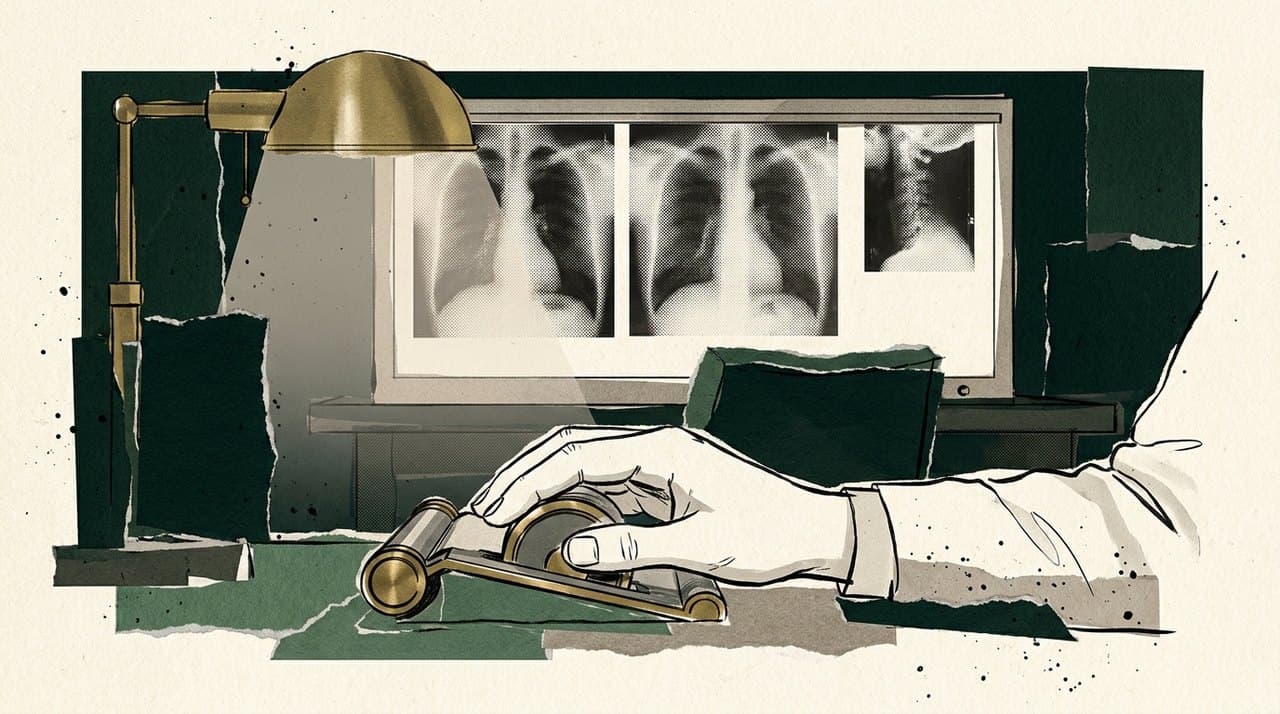
A diagnostic radiologist is the doctor who reads X-rays, CT scans, MRIs, and ultrasounds to find out what is wrong inside a patient's body, then writes the report that tells the treating doctor what to do next.

Median pay (US)

$420,860

2025 · $202.34 an hour

O*NET source

Job outlook

Average

O*NET's band for this category is 3% to 4%, 2024-2034

O*NET source

To get in the door

Graduate or professional degree

Most of these occupations require graduate school.

Openings a year

800

projected, nationally

O*NET source

What the day actually looks like

  • Read and interpret imaging studies at a multi-screen workstation: X-ray, CT, MRI, PET, nuclear medicine, mammography, and ultrasound.
  • Write the interpretive report for every study. O*NET rates 'Prepare comprehensive interpretive reports of findings' as the single most important task in the job, at 100 out of 100.
  • Compare today's images against a patient's older scans to see whether a tumor, fracture, bleed, or infection is changing.
  • Call the referring doctor with results, especially urgent findings, and sometimes explain results to patients and families. O*NET reports that 94% of radiologists have telephone conversations daily.
  • Perform image-guided procedures such as needle biopsies, drain placements, and angioplasty, depending on the practice and subspecialty.

Skills you need first

  • Pattern recognition in cluttered pictures. O*NET rates 'flexibility of closure' (spotting a shape hidden in a busy image) at 72 and near vision at 75 for this job. Both matter, though neither sits at the top of the ability list.
  • Inductive and deductive reasoning, the two highest-rated abilities in the occupation at 88 and 85, for assembling a diagnosis out of scattered clues.
  • Clear writing under time pressure. Every read ends in a written report, and O*NET rates writing at 78 importance with 73% of radiologists facing strict deadlines daily.
  • Anatomy held in three dimensions, because you are looking at thin slices of a body and rebuilding the whole in your head.
  • Biology plus physics: how tissue behaves, and how X-rays, magnetic fields, and sound waves turn into an image you can trust.
  • Tolerance for high-stakes calls. O*NET reports that 55% of radiologists say the consequences of a mistake in their job are extremely serious.

How long people stay

Radiologists are leaving the workforce earlier than they used to. The ACR Bulletin (February 5, 2026), reporting a 2025 Harvey L. Neiman Health Policy Institute study, states that U.S. radiologist attrition more than doubled from 1.1% per year in 2014 to 2.5% in 2022, having already climbed to 2.0% by 2019 before the pandemic. Inside that number: subspecialists were 37% more likely to leave than generalists, non-academic radiologists 37% more likely than academics, and female radiologists had 26% higher attrition, with male radiologists averaging 1.9 to 3.5 more years of practice. The job is indoor and mostly seated, but it is not low-stress: O*NET reports 64% work more than 40 hours a week, 73% meet strict deadlines daily, 63% are exposed to radiation daily, and 55% say mistakes carry extremely serious consequences. A typical retirement age and a median years-in-practice figure for U.S. radiologists were not verified and are not published here.

Where it is needed, and the different ways to do it

Demand is outrunning supply, and the profession's own researchers are the ones saying so. The Harvey L. Neiman Health Policy Institute, reporting two companion studies published February 12, 2025 in the Journal of the American College of Radiology, projects U.S. radiologist supply growing 25.7% from 2023 to 2055 if residency positions do not expand, against imaging demand growing 16.9% to 26.9% depending on modality, while the U.S. population aged 75 and older grows between 51.5% and 282.1%. Researcher Eric Christensen's conclusion: "the present radiologist shortage is projected to persist unless steps are taken to grow the workforce and/or decrease per person imaging utilization." The ACR Bulletin (February 5, 2026) adds that attrition more than doubled between 2014 and 2022 and that projected imaging demand by 2055 ranges from a 17% increase in MRI to a 25% increase in CT. Training seats, not student interest, are the bottleneck. For scale, O*NET prints employment of 28,200 radiologists in 2024.

Hospital radiology department

A reading room inside a hospital, covering the emergency department, ICU, and inpatient floors. Interruption-heavy, urgent, and usually involves overnight and weekend call.

Outpatient imaging center

A freestanding clinic running scheduled scans. Higher volume of routine studies and more predictable hours than hospital work.

Teleradiology and remote reading

Reading studies from home or a regional workstation for hospitals in other cities or time zones, including overnight coverage. One of the few physician jobs that can genuinely be done remotely.

Academic medical center

Reading cases plus teaching residents and running research. Cleveland Clinic runs an ACGME-accredited diagnostic radiology residency here in Cleveland, listed in the schools section below.

Subspecialty practice

Reading one area all day: neuroradiology, musculoskeletal, breast imaging, pediatric radiology, cardiothoracic, or nuclear medicine. Most radiologists subspecialize after residency.

Interventional suite

Using live imaging to guide needles and catheters for biopsies, drains, and angioplasty instead of only reading images. This is a related but separately certified path (IR/DR) with its own residency.

AI and this career

exposure: high

Radiology is the most AI-saturated field in medicine, and the best available evidence shows AI changing how the work is done rather than removing the person doing it. Radiology is by far the largest category on the FDA's list of authorized AI-enabled medical devices. In the MASAI randomized trial in Sweden, an AI-supported reading workflow cut radiologists' screen-reading workload by 44.3% in the 2023 interim safety analysis of 80,033 women, while a radiologist still read every single case; the separate primary-endpoint paper, covering 105,934 women, reported higher cancer detection with unchanged specificity. What is genuinely unsettled is whether any of this makes the job feel better. A large survey of radiologists in China found that frequent AI use was associated with more burnout rather than less. That study asked everyone at a single point in time, so it shows an association and not proof that AI causes burnout, and it describes Chinese practice rather than U.S. practice.

Tasks likely to change

  • First-pass detection and triage. AI now flags and prioritizes suspected findings such as intracranial hemorrhage, pulmonary embolism, and lung nodules, so the order in which a radiologist opens the worklist is increasingly set by software rather than by arrival time.
  • Screening volume. In the MASAI randomized trial in Sweden, AI triaged mammograms to single or double reading. The 2023 interim safety analysis (80,033 women) reported screen-reading workload cut by 44.3%. The separate primary-endpoint paper (105,934 women) reported sensitivity of 80.5% with AI support versus 73.8% without, identical specificity of 98.5% in both groups, and a non-inferior interval cancer rate.
  • Measurement and quantification. Volumes, nodule sizing, cardiac function, bone age, and change-over-time comparisons are increasingly computed by software rather than estimated by eye.
  • Report production. Structured and draft reports generated from images are beginning to shift the radiologist's job toward verifying and correcting text rather than composing every report from scratch. This is the least settled of the four. No study we could read establishes how common draft reports actually are in U.S. practice, so treat it as a direction to watch, not a done deal.

Tasks that stay human

  • Accountability for the read. The American College of Radiology reinforced at its 2025 annual meeting that 'AI serves to support radiologists, not to replace them,' and stressed human oversight to catch AI errors, noting that some physicians struggled to detect errors the AI produced.
  • The hard cases: unusual anatomy, poor-quality studies, contradictory findings, and the patient whose history does not match the picture. MASAI kept a human reader on every case for exactly this reason.
  • Talking to humans. O*NET rates 'Assisting and Caring for Others' as the top work activity at 97, with 94% of radiologists on the phone daily. Calling a surgeon at 2am about a finding that changes the plan is not a software feature.
  • Image-guided procedures. Biopsies, drains, and catheter work are physical acts performed on a live patient and stay with the physician.

What diagnostic radiologist work may look like

A day in this job ten years out may look more like judging than hunting. The worklist likely arrives pre-sorted, with the possible bleed and the possible clot already pushed to the top and outlined on the image, and routine screening studies already filtered so only the suspicious ones need a second human look. Measurements may be filled in before you open the case, and a draft report may be waiting for you to correct rather than write. If imaging demand keeps climbing the way the ACR's own projections suggest, that new speed will probably be absorbed by reading more studies rather than by working fewer hours, and that is the part most likely to feel worse instead of better. The largest study on this question, a single-point-in-time survey of 6,726 radiologists across 1,143 hospitals in China, found that frequent AI users reported more burnout, not less, with the effect concentrated among those already carrying the heaviest workloads. Because everyone was surveyed at once, that is an association rather than evidence that AI caused the burnout, and it describes Chinese practice, not American practice. The radiologist's value may shift toward the cases where the software hedges, toward recognizing when the machine is confidently wrong, and toward being the person who picks up the phone and takes responsibility for what a scan means for one specific patient. None of this is settled. A 2026 review by the ACR's own Radiology Leadership Institute concluded that AI's effect on radiologist burnout remains a black box, with the final impact yet to be determined.

Sources:[1][2][3][4]

Open questions on this career

  • A Bureau of Labor Statistics data series number had been offered as proof the salary was checked. We could not confirm that the series number is real, so it is gone. A citation nobody can look up is not a citation.
  • The pay year now reads 2025 instead of May 2025. May 2025 is very likely the correct survey period, but no page we could open prints that month next to the dollar figure.
  • Case Western correction. We had written that the secondary application is by invitation only. The school's admissions page says the opposite: applicants scoring 502 or higher on the MCAT automatically receive the secondary application. That is a meaningful difference for a student deciding whether to apply.

Pay and outlook come from O*NET, the US Department of Labor's occupation site, and every figure links back to it. We do not publish tuition or cost figures here: those change often, so use each school's own page and phone number below. Tell Mr. Mendoza if anything looks wrong.

Where you can train for it

4 programs

Read these as minimums, not targets.Meeting the numbers below is what lets you apply; it is not what gets you in. Selective programs admit far fewer people than apply, and admitted students are usually well above the minimum. Call the program and ask what last year's admitted class actually looked like. That one phone call is worth more than any number on this page.

Case Western Reserve University School of Medicine

Cleveland, OH · MD (Doctor of Medicine)

MD University Program

What they ask for

  • A bachelor's degree from an accredited U.S. or Canadian college completed before matriculation.
  • Prerequisite coursework by matriculation: two semesters of general chemistry with two semesters of lab, one semester of organic chemistry with lab, one semester of biochemistry including metabolism, and one semester of writing or college English.
  • MCAT required. The admissions page states that applicants scoring 502 or greater automatically receive the secondary application.
  • Selective admission: the entering class of 2025 averaged a 3.90 cumulative GPA, a 3.87 science GPA, and a 517 MCAT.
  • Primary application through AMCAS.

Cleveland's own medical school, on the Health Education Campus at 9501 Euclid Avenue, a city bus ride from John Hay. No medical school makes you a radiologist; radiology training happens afterward, in residency. The Office of Admissions phone listed here is printed on the parent admissions page, case.edu/medicine/md/admission, rather than on the requirements page linked above. For cost, use the school's own cost of attendance page or call financial aid; no dollar figures are published here.

The Ohio State University College of Medicine

Columbus, OH · MD (Doctor of Medicine)

MD Program

What they ask for

  • Prerequisites, all completed within ten years of enrollment and with a grade of C- or higher: two semesters of biology, two semesters of general chemistry with lab, two semesters of organic chemistry with a year of lab, one semester of biochemistry, and two semesters of physics with lab.
  • MCAT required, and it must be taken within three years of your application.
  • At least two letters of recommendation, with at least one from a biology, chemistry, physics, or math professor or from a premedical committee, submitted through the AMCAS letter service.
  • Primary application through AMCAS.

Ohio's largest public MD program. The College of Medicine cost page links a PDF rather than printing figures, so call Admissions or open the university's own cost of attendance page for current resident and non-resident tuition. Do not trust third-party tuition numbers for this program, including any you may find quoted elsewhere.

The University of Akron

Akron, OH · Bachelor's degree at Akron plus provisional admission to the Northeast Ohio Medical University MD program

NEOMED Early Assurance Pathway (EAP)

What they ask for

  • You apply as a current Akron student in the fall of your second year, not from high school. You must have completed a year at Akron as a full-time degree-seeking student after high school graduation, and a year of College Credit Plus does not satisfy this.
  • A sliding scale of test score plus GPA/BCPM: 26 ACT or 1240 SAT with a 3.4 or higher, 25 or 1210 with a 3.5, 24 or 1180 with a 3.6, 23 or 1140 with a 3.7. Alternatively, good standing in the Williams Honors College with a 3.4 or higher.
  • Successful completion of 20 credits of biology, chemistry, physics, or math and statistics coursework by the time you apply.
  • U.S. citizen or permanent resident at the time of application.
  • An EAP application, essays, and a resume submitted to the Pre-Health Adviser, then selection by the UA Pre-Health Committee followed by an interview with NEOMED.

The closest thing to an early on-ramp to medical school near Cleveland. Akron states the EAP acceptance rate is over 80%, against roughly 40% of applicants nationally who are admitted to any MD school, and that preference goes to Ohio residents or students with a demonstrated Ohio connection. Your high school ACT or SAT score is still part of the EAP formula, which is a concrete reason to take that test seriously as a junior. The phone listed is the UA Office of Admissions line printed on this page; the pathway itself routes through the Pre-Health Adviser.

Cleveland Clinic

Cleveland, OH · Four-year ACGME-accredited diagnostic radiology residency, the training that leads to American Board of Radiology certification

Diagnostic Radiology Residency

What they ask for

  • An MD or DO degree and a medical school transcript. Applications are accepted only through ERAS using the standard MyERAS application.
  • USMLE Step 1 and Step 2 transcripts. The program states that COMLEX alone will not suffice.
  • Three letters of recommendation, at least one of them from radiology, plus a personal statement.
  • For the cycle shown on the page, complete applications had to be received through ERAS by October 31, 2025, with the Dean's letter and ECFMG certification for international medical graduates due before February 1, 2026. These dates change every year, so check the page.

This is the step where you actually become a radiologist, after the MD. The program page lists a four-year program, 32 residents, over 120 subspecialized staff radiologists at the main campus, and Joseph Veniero, MD, PhD as program director; the listed program manager is Lauren Cunningham (cunninl3@ccf.org). Residency is paid training rather than tuition-paying study, but no salary figure is printed on the page, so none is reported. No program or admissions phone number appears on the official page either, so none is listed. The only numbers printed there are general Cleveland Clinic lines (800.223.2273 and a referring-physician line, 855.733.3712), neither of which reaches this program. A program phone number that showed up in search results was deliberately left out.

Program page phone not confirmed: use the program page
Need help or have feedback?
Ask a question Family feedback